
Diode vs Nd:YAG laser hair reduction — which is safer for Indian skin?

Diode vs Nd:YAG laser hair reduction — which is safer for Indian skin?

If you’ve ever walked into a salon laser room in Bengaluru and seen the same beige machine being used on every patient, regardless of skin tone, that’s the problem this post exists to solve. Indian skin doesn’t respond to lasers the way lighter European or East Asian skin does, and the wrong machine on the wrong patient can leave behind exactly the pigmentation it was supposed to remove.

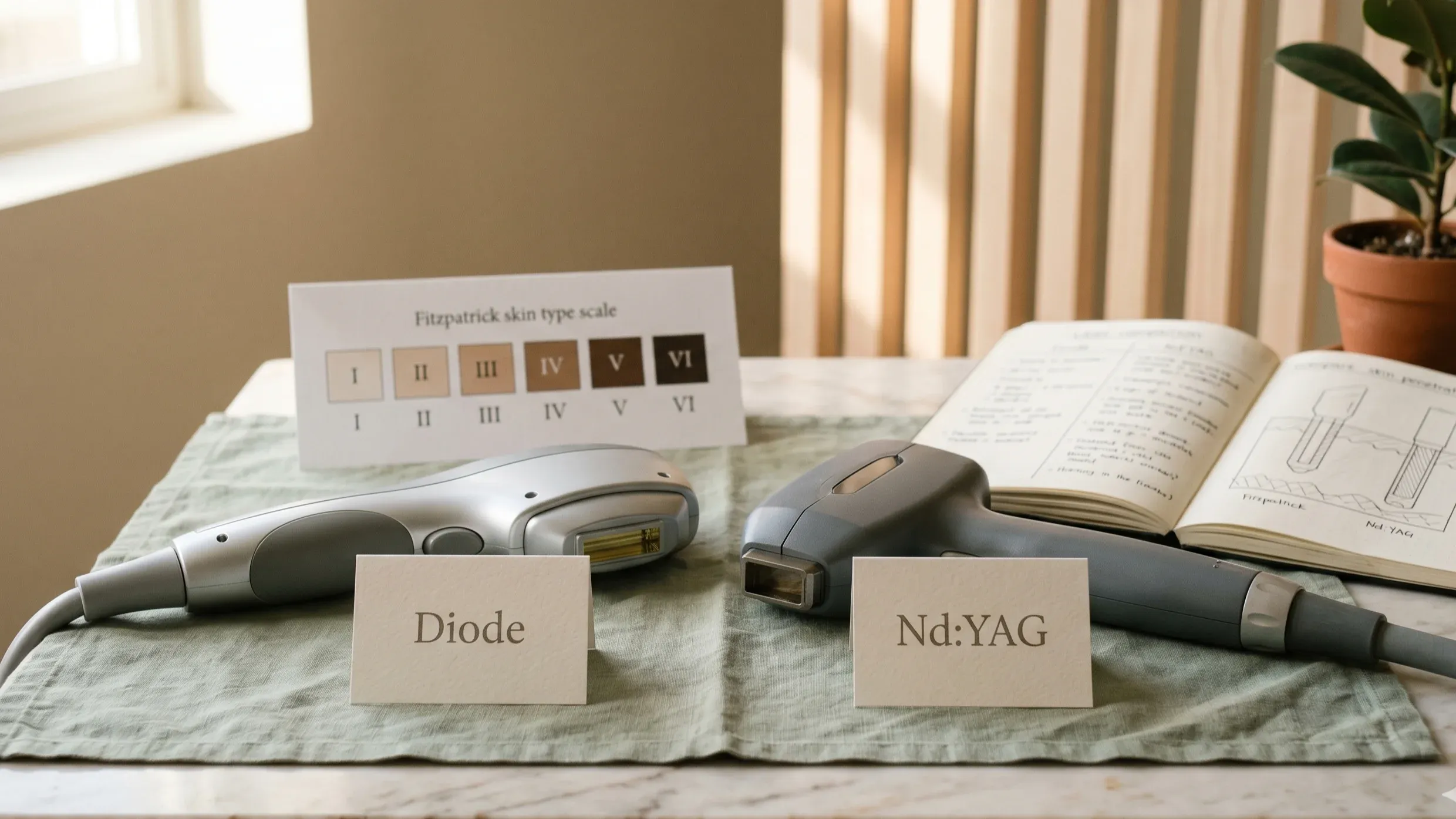
There are two lasers we actually trust on melanin-rich Indian skin: diode and Nd:YAG. They’re both medical-grade, both safer than older alexandrite lasers, and they work differently. Here’s when to choose which.

The skin-tone problem with lasers

Laser hair reduction works because hair follicles contain melanin. The laser fires a precise wavelength of light that melanin absorbs strongly. The follicle heats up, the stem cells around it are damaged, and over time the hair grows back finer and slower — eventually stopping in most cases.

The catch on Indian skin (Fitzpatrick III–V): your skin also contains melanin. A lot of it. So the same laser that targets the follicle can also heat the surrounding skin, causing burns, blistering, post-inflammatory hyperpigmentation, or (in severe cases) hypopigmented patches that take months to recover.

The difference between a safe laser session and a damaging one is mostly about wavelength. Longer wavelengths penetrate deeper and are absorbed less by surface skin melanin, making them safer on darker tones.

Diode laser — the workhorse

Diode lasers operate at around 800–810 nm. They’re the most common medical-grade laser for hair removal worldwide, and they’re the workhorse for body hair on Indian skin tones up to Fitzpatrick IV (medium to medium-deep brown).

Where diode shines:

  • Larger body areas: legs, arms, back, chest
  • Dense, coarse hair
  • Lighter Indian skin tones (Fitzpatrick III–IV)
  • Fast treatment times — modern diode handpieces cover large areas quickly with cooling

Where diode struggles:

  • Fitzpatrick V–VI (deep brown to dark skin)
  • Areas with recent tanning
  • Sensitive facial areas where less depth is needed

A good diode laser with proper cooling (sapphire-tip or contact cooling) and conservative energy settings can treat most Indian patients safely. The skill is in the operator picking the right settings — not just the right machine.

Nd:YAG laser — the safer choice for darker skin

Nd:YAG lasers operate at a longer wavelength of 1,064 nm. That’s a critical difference: at 1,064 nm, surface skin melanin absorbs far less of the laser energy, so the laser passes through more safely and concentrates its effect deeper, on the follicle.

Where Nd:YAG shines:

  • Fitzpatrick V–VI (deep brown to dark skin tones)
  • Facial hair where precision matters
  • Patients with recent tanning or sun exposure
  • Patients prone to post-inflammatory pigmentation

Where Nd:YAG has trade-offs:

  • Less powerful at destroying very fine hair
  • Slower treatment times for large body areas
  • Slightly more discomfort per pulse (longer wavelength carries more sensation)
  • May need slightly more sessions for full reduction

For patients with deeper Indian skin tones, Nd:YAG isn’t just the safer option — it’s often the only option that won’t cause pigmentation issues.

How we choose between them at SkinWise

We don’t pick one machine per patient and use it everywhere. We pick per skin tone and per body area:

Patient skin toneBody areasFace / sensitive areas
Fitzpatrick III (medium Indian)DiodeDiode (low energy) or Nd:YAG
Fitzpatrick IV (medium-deep)DiodeNd:YAG
Fitzpatrick V (deep brown)Nd:YAG, occasional diode at conservative settingsNd:YAG
Fitzpatrick VI (dark)Nd:YAG onlyNd:YAG only

We also adjust settings every session based on how the previous one went. Mild redness for 24 hours is normal. Anything more — pigmentation, bumps, lasting marks — means we step the settings down or switch wavelengths for the next session.

What about older lasers?

You’ll occasionally hear about alexandrite (755 nm) and ruby (694 nm) lasers in older clinics. Both are excellent on light skin and dangerous on Indian skin. If a clinic is using alexandrite as their primary machine for Indian patients, it’s a red flag — particularly for Fitzpatrick V and above.

Salon-grade IPL (intense pulsed light) is different again. IPL isn’t a laser at all — it’s a broad-spectrum light. It’s underpowered for permanent reduction and rarely calibrated correctly for darker skin. Most “laser hair reduction” marketing at non-medical clinics is IPL, which is why people often see no real result and assume “laser doesn’t work for me.”

How many sessions will I need?

Honest range for Indian skin, regardless of machine:

  • 6–8 sessions for face, in 4–6 week intervals
  • 6–8 sessions for body areas like underarms and bikini, 6–8 weeks apart
  • 8–10 sessions for very coarse or hormonal hair (PCOS facial hair)
  • Annual touch-ups after the main course

Each session reduces hair density by 15–25%. Anyone promising 100% removal in 4 sessions is overselling — the hair growth cycle alone limits how much one session can do.

What about pain?

Sensation:

  • Diode: feels like a rubber band snapping against the skin, eased by integrated cooling
  • Nd:YAG: slightly more — a brief flash of heat per pulse, but the contact cooling tip reduces it significantly

Sensitive areas — upper lip, bikini, areola — get topical numbing cream 30 minutes before the session.

Frequently asked questions

Can I switch between diode and Nd:YAG between sessions? Yes — and we sometimes do, especially if your skin pigments slightly after a diode session. We’ll move to Nd:YAG and step the energy down.

My friend got great results with “laser” at a salon for ₹500 a session. Why are medical-grade sessions ₹2,500+? Because medical-grade lasers cost ₹40–80 lakhs, are operated by trained dermatology staff, and use disposable / sterilised handpieces. Salon machines at ₹500 a session are almost always IPL or low-powered diode units run at energy levels too low to do permanent follicle damage.

Can I do laser hair reduction while pregnant? We avoid it during pregnancy. Not because it’s known to be harmful — there’s no evidence of fetal harm — but because the skin is more pigment-sensitive and reactions are unpredictable.

What if I have PCOS facial hair? Laser still works, but you’ll need more sessions (8–12 instead of 6–8) and ongoing maintenance because the hormonal driver keeps producing new hair. We pair it with the rest of a PCOS skin and hair plan.

Will laser remove existing hair pigmentation on my underarms / inner thighs? Pigmentation in these areas isn’t from hair — it’s from friction, hormones and shaving irritation. Laser hair reduction removes the trigger (the hair, and the shaving / waxing routine around it), and the pigmentation often fades over months. We sometimes pair it with a gentle chemical peel for faster results.

Where to go from here

If you’re considering laser hair reduction and want a real conversation about your skin tone, hair type and the right protocol, book a laser hair reduction consultation. We’ll do a test patch in the first session and tell you honestly how many sessions you’re likely to need.

Related reading:

Book a consultation with Dr Khushboo

Book consultation